WORM
Worm-inspired colonoscopy robot
A worm-inspired robot that crawls through the colon on its own. Each foot switches between gripping and slipping by stretching an adhesive pad, so the robot moves forward without lifting its feet off the tissue. I led its hardware design, prototyping, and control development, working closely with a materials lab that developed the adhesive.
Tested ex vivo · Manuscript under review
Why WORM
In a standard colonoscopy, a long scope is pushed into the colon from outside. Because the colon is soft, pushing can deform it: the scope can loop, the procedure can be uncomfortable, and the tissue can be injured. A robot that moves through the colon on its own avoids that pushing. To be useful, it has to fit through a narrow, soft passage, keep steady contact with the tissue, and treat it gently.
Worms move through soft ground by anchoring one part of the body while another moves forward. WORM does the same with two adhesive feet. Instead of lifting a foot to step, it changes how strongly the foot sticks: one foot anchors while the other slips forward, so both feet stay on the tissue the whole time.
Design and build
The engineering problem was turning a material property into locomotion. The adhesive pad, developed by our collaborators in a materials lab, grips strongly when relaxed and loses most of its grip when stretched. WORM needed a foot that could stretch its pad on command inside a narrow colon, and a body that coordinates two such feet to crawl forward without losing contact with the tissue.
The narrow colon limited how large the actuators could be, and a small, low-torque servo on its own could not stretch the pad far enough to release it. So I designed each foot as a truss driven by a rack and pinion: the servo turns the pinion, the rack pushes the truss, and the truss amplifies that motion to stretch the pad to twice its length.
The body between the feet has its own servo and rack and pinion, which push the feet apart and pull them together. As the body extends, the rear foot anchors and the front foot slips forward; as it contracts, the front foot anchors and the rear foot follows. Repeating this cycle moves the robot in one direction.
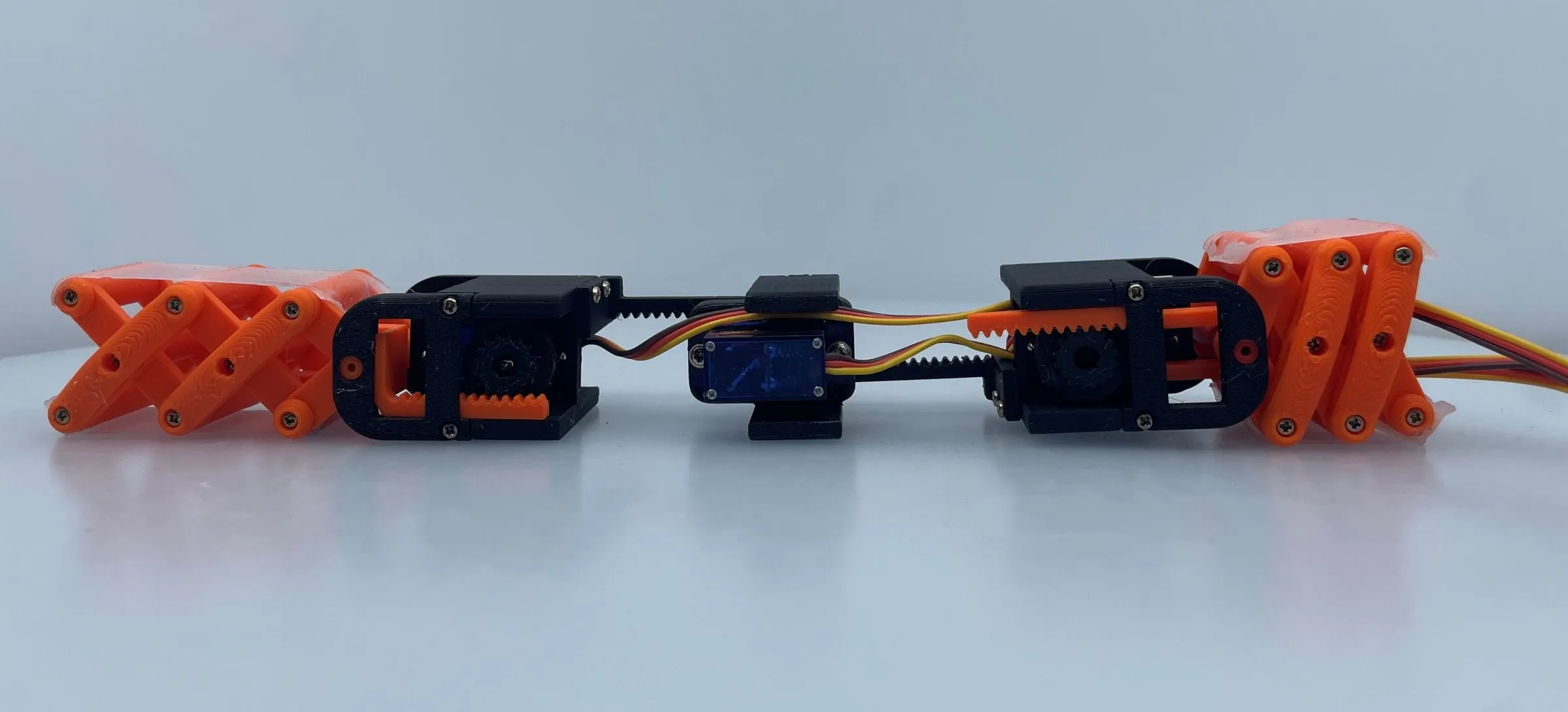
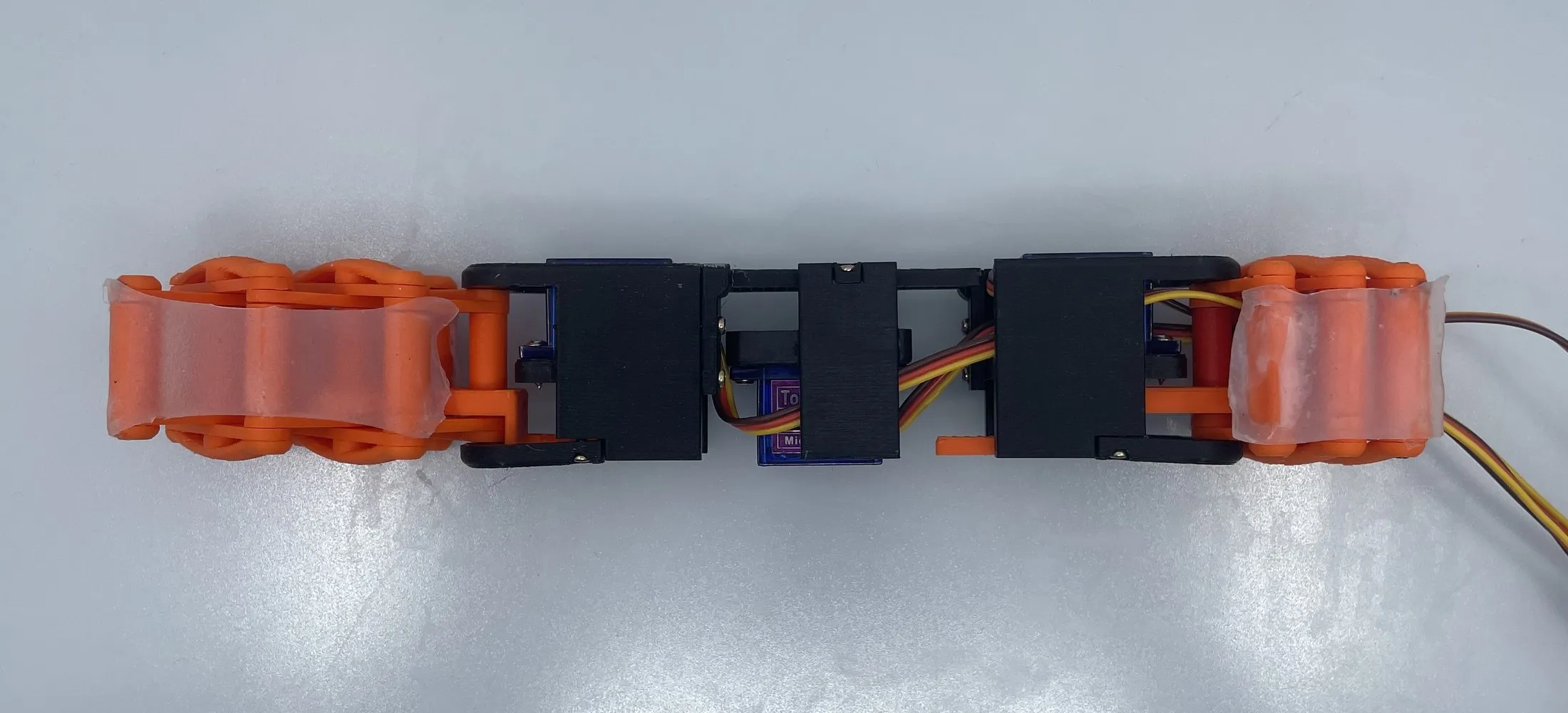
Getting there took several rounds: a pin-jointed foot, then the truss foot, then a smaller foot and a narrower body to fit inside the colon.
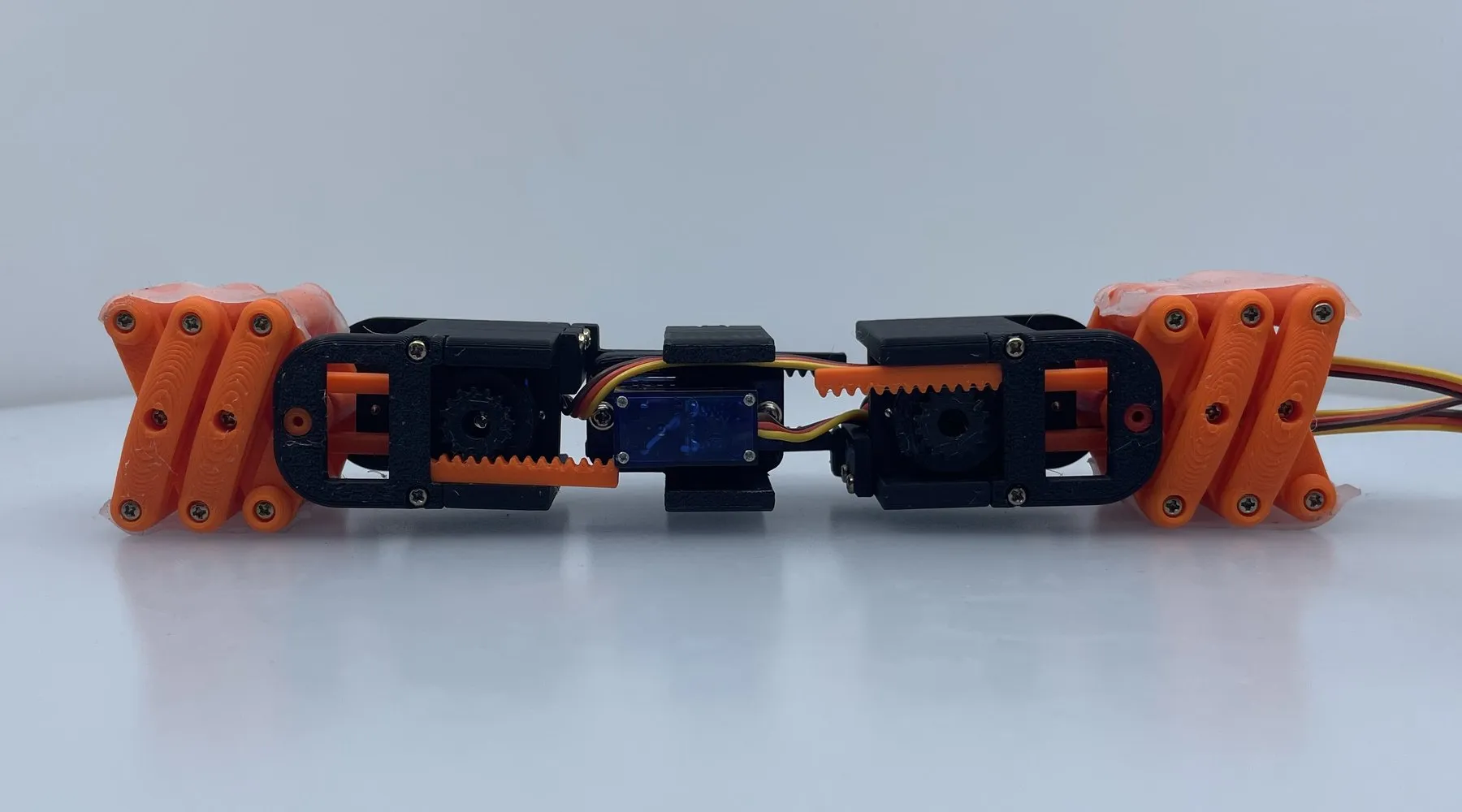
Testing
I tested WORM on ex vivo bovine colon tissue. Inside a flat segment of colon, it crawled from one end to the other, reaching the far end of the tested section in 16 locomotion cycles. With plain silicone pads, which do not switch, the same robot stayed near where it started.
Role and collaboration
I led the hardware design, prototyping, and control development of WORM: the foot and body mechanisms, the 3D-printed prototypes, the Arduino control, and the ex vivo crawling experiments.
WORM was a close collaboration with a materials lab that developed the adhesive. We worked in a loop: I tested each new version of their pads on the robot, we reviewed the results together in joint lab meetings, and each side took the other's feedback back into its own work. They refined the material, and I reworked the feet, the body, and the gait. Then we brought the two together and tested again. Even though we came from different fields, that back-and-forth is what got the robot and the material working together. The work is part of a manuscript currently under review, so the details here are kept brief.
What came next
WORM can only crawl in a straight line, and the colon is a narrow setting. That limit shaped my next robot. I looked for a more everyday problem, pipe inspection, and led a team of six to build Gyecko, a pipe robot with gecko-inspired feet that can also turn.